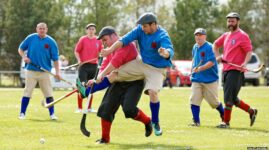
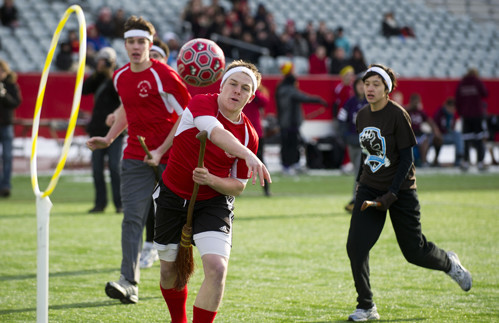
Quidditch was a fictional sport where wizards would fly on broom sticks in the wizarding world of Harry Potter. This fictional game is fictional no more. Potter fans all over the world have turned this game into a phenomenon with rules and regulations and even a world cup!
There are multiple types of balls that are used in this sport as well as regulations for their size and use. Here is the rules for the different balls according to the US Quidditch Rulebook:
2.3. GAME BALLS
2.3.1. The quaffle
The quaffle must be:
A. A volleyball
B. Between 25.6 and 26.4 inches in circumference.
C. The quaffle must maintain its spherical shape and must be neither inflated all the way nor so flat that the average player could grip a bulk of the leather in one hand.
2.3.2. Bludgers
The three bludgers must be:
A. Spherical balls made of flexible rubber or rubber-like covers (such as dodgeballs).
B. 8.5 inches in diameter, 26.7 inches in circumference.
C. The bludgers must maintain their spherical shape and must be neither inflated all the
way nor so flat that the average player could grip a bulk of the rubber in one hand.
2.3.3. The snitch
The snitch must be:
A. A standard tennis ball held within a tail.
i. The tail must have a visible and unobstructed length of between 10 and 12 inches.
a. If the tail is attached to the outside of the shorts, up to 2 inches of the attachment may be counted toward this minimum length.
B. The tail must be tucked in or attached to the shorts of the snitch runner in a manner that is secure and allows for the removal of the tail by the seeker.
2.3.4.Defective balls mid-play
If a game ball becomes defective (e.g. deflates) while in play, the head referee must stop play to replace the ball. The following conditions apply:
A. The head referee must stop play immediately when any ball becomes defective.
B. If a ball was in midair when it became defective, the replaced or repaired ball is returned
to the player who last held possession, except the quaffle after a good goal.
i. If this player is knocked out or dismounted before play is stopped, then the ball is
given to the nearest eligible player on the same team to this player’s current location.
a. If no such player exists, then the ball shall be left at the player’s current location.
C. No goals or knockouts may happen with a ball an official recognized as defective before
the knockout or goal occurred.
D. If a bludger becomes defective while hitting a player, the knockout counts and the
bludger is considered dead.
i. If the bludger becomes defective in the final motion of being otherwise successfully
caught, that catch shall count.
E. If the snitch becomes defective during the snitch catch (e.g. the tail breaks in half and the
seeker gets half of it), the catch counts if the seeker cleanly removed the actual ball.
i. If the snitch becomes defective before the catch, the catch must be called no good.
References:
US Quidditch Rulebook – https://web.archive.org/web/20211028211547/https://www.usquidditch.org/files/USQ_Rulebook_15.pdf
Photo – http://www.bu.edu/today/2012/warm-up-at-winterfest/