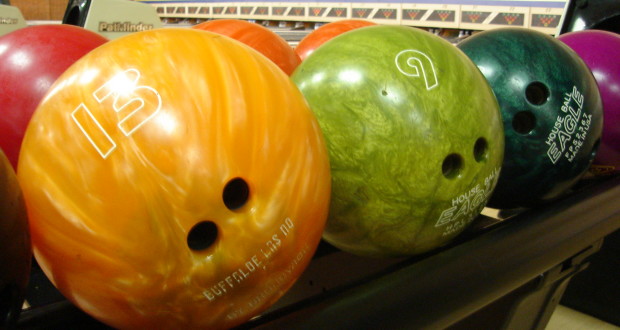
You are currently viewing Attack of the Bowling Balls! Scary!!!

Who said bowling balls were boring?  The NCAA allows for normal wear and tear, but make sure to include a serial number before you roll the first ball.

Rule 2 – Player Equipment

2.1 Bowling Balls for Competition

  • a. Bowling Ball—Approval. Bowling balls used in NCAA competition shall:
    • 1) Meet the equipment specification (as determined by the USBC) at time of manufacture for public use;
    • 2) Meet the minimum or maximum specifications for weight, size, markings, logos, holes, balance, surface preparation and surface hardness before the scoring of any competition; and
    • 3) Be drilled and fitted for the student-athlete before arrival at the facility for official practice sessions or scoring. Nondrilled bowling balls are not to be brought to the facility for use. Balls shall not be purchased and drilled for competition during the event except to replace a ball that has been damaged beyond repair; the process may not occur without approval from the head official.
    • 4) There is a limit of six (6) balls per player per event. Prior to the start of the first daily warmup session of the event, teams must submit a ball registration form to the head official or tournament director that includes all bowling balls that will be used for all players for the duration of the event.
      PENALTY—Failure to submit a ball registration form will be treated as an unfair tactic (See Rule 7.10.a). Once competition has started, possession of more than six (6) balls at any time will be deemed an unfair tactic (See Rule 7.10.a). Upon the first violation, the player and the team will receive a warning and the additional ball will be removed for the remainder of the event. Any subsequent violations by any member of the team will result in escalating penalties. (See Rule 7.10.a).

A.R. 2.a.1.4. The coach from ASU fails to turn in the Ball Registration Form prior to the start of the first daily warmup session of the event. Upon learning that ASU has started scoring, the head official/tournament director shall notify the coach to stop scoring until the form has been submitted. All scores achieved without a form submitted shall be changed to zero. The coach will be warned
that the form must be submitted prior to resumption of scoring. If the coach continues to fail to turn in the form, the match will be forfeited under Rule 8.2.e. All subsequent matches will be forfeited until the form is submitted.

  • b. Bowling Ball—Weight, Size, Markings and Holes. The circumference of a ball shall not be more than 27 inches, nor shall it weigh more than 16 pounds. The height of the ball shall not exceed 8.59 inches. The diameter of the ball shall be constant. The surface of a ball is to be free of all depressions or grooves of specific pattern, except for holes or indentations used for gripping the ball and incidental chipping or marring caused by wear. Any bowling ball used in NCAA competition shall be identifiable as an approved bowling ball according to USBC standards. Manufacturer identification labels (logos) are also required. Additionally, for identification purposes, each ball is required to have some form of serial number (engraved or re-engraved by the player) legible on the bowling ball at all times.
    The following limitations govern drilling holes in a ball:
    • 1) Holes or indentions, not to exceed five, for gripping purposes.
    • 2) One vent hole to each finger and/or thumb hole, not to exceed ¼ inch in diameter.
    • 3) Balance holes are not allowed. Any delivery made without a thumb in the thumb hole is illegal and will result in a zero for the delivery.
  • c. Bowling Ball—Balance. After drilling, the following tolerances are allowed in the balance of the ball:
    • 1) Balance—Ball Weighing 10.0 Pounds or More.
      • a) There shall not be more than 3 ounces difference between the top of the ball (gripping holes side) and the bottom (solid side opposite the gripping holes).
      • b) Not more than 3 ounces difference between the half of the ball to the left and the half of the ball to the right of the center of grip (side weight).
      • c) Not more than 3 ounces difference between the half of the ball toward the thumb hole side of the center of grip and toward the finger holes side of the center of grip (thumb/finger weight).
      • d) A ball used without any gripping holes or indentations may not have more than 3 ounces of difference between any two halves of the ball.
      • e) If a bowler does not have a thumb hole and drills a ball to meet the new 3 ounces. of imbalance requirement, there must be a scribed or engraved “+” near the center of the palm to indicate the grip orientation. The ball must be delivered in the marked orientation (i.e., palm must cover the “+”)
    • 2) Ball Weighing Less than 10.0 Pounds.
      • a) There shall not be more than 2 ounces difference between the top half of the ball (gripping holes side) and the bottom half of the ball (side opposite the gripping holes).
      • b) There shall not be more than a ¾ ounce difference between the top of the ball (gripping holes side) and the bottom (solid side opposite the gripping holes).
      • c) There shall not be more than a ¾ ounce difference between the sides to the right and left, or between the front and back of the gripping holes.
      • d) A ball used without any gripping holes or indentations may not have more than 3/4 ounce of difference between any two halves of the ball.
  • d. Balance—Inspection/Altering of Ball Weights. Equipment is subject to random inspection or testing by an official before or after competition. Any bowling ball that is identified by an official as noncompliant with NCAA rules shall not be allowed to be used in official event competition. Equipment that does not meet approval of the weight or balance rules shall be brought into compliance at the event site if the equipment and/or services are available at the facility.
    PENALTY—Frames completed with equipment that does not meet weight or balance requirements shall be registered by the head official under unfair tactics. (See Rule 7.10.a.)
  • e. Bowling Ball—Surface Hardness. The surface hardness of a ball shall be not less than 72 on the Durometer Scale. The use of chemicals, solvents or other methods to change the surface hardness of the ball, is prohibited. Equipment is subject to random inspection and/or testing by an official before or after competition.
    PENALTY—Frames completed with equipment that does not meet surface hardness requirements shall be registered by the head official under unfair tactics. (See Rule 7.10.a.)
  • f. Bowling Ball—Removable/Movable Devices. Movable devices are not permitted in a ball, unless it is a device for changing the finger span or the size of finger and thumb holes, provided the device is locked in position during delivery and cannot be removed from the ball without destroying the device. Removable devices shall be permitted, provided:
  • 1) Such devices are used for changing the span, pitch or the size of the gripping holes.
  • 2) The devices are constructed of a nonmetal material.
  • 3) The devices are locked in position during delivery.
  • 4) No device shall be employed for the purpose of adjusting the static balance of the ball.
  • 5) No voids shall be permitted under the device.
  • g. Bowling Ball—Adding to Internal Materials. The introduction of metal or any other substance not compatible to the original material used in the manufacture of the ball is prohibited. Also, altering a ball in any way to increase its weight or cause it to be out of balance beyond the tolerances is prohibited.
  • h. Bowling Ball—Slugs and Inserts (Grips). Slugs may be inserted for the purpose of redrilling a ball. Designs can be embedded in a ball as guides, or for observation and identification purposes, provided the designs are flush with the outer surface of the ball. There shall not be interior voids and the slugs or designs are to be of material similar to, although not exactly the same as, the original material out of which the ball was made; they shall otherwise comply with all bowling ball specifications. No foreign material shall be placed on the outer surface of the ball. Finger and/or thumb inserts (grips) are allowed to be used, provided the designs are flush with the outer surface of the ball.
  • i. Special Equipment to Grip Bowling Ball. A player is allowed to use special equipment to aid in grasping and delivering the ball if it is in place of a hand or major portion thereof, lost by amputation or otherwise.

References:
NCAA Bowling Rules and Interpretations- https://www.ncaapublications.com/productdownloads/WB25.pdf
Photo – en.wikipedia.org/wiki/Bowling_ball2.1 Bowling Balls for Competition

Sports

Sports Balls is a group of sports enthusiasts interested in the official specifications of balls used as sports equipment. As hobbyists, we are continually amazed at the level of detail used to accomplish fair play.